Travel agency operations: Why disconnected systems are slowing agency growth
Discover how disconnected systems create manual work, increase operational costs, and make it harder for travel agencies to scale, automate, and adopt AI.

The article in short
Many travel agencies view manual work, rising costs, reporting challenges, and disconnected systems as separate operational issues. The benchmark data suggests they may be more closely connected than they appear.
This article explores how disconnected systems create hidden inefficiencies that impact productivity, profitability, and growth. You’ll discover why seemingly small administrative tasks can accumulate into significant operational costs, why fragmented data makes automation and AI harder to implement, and why some agencies scale more efficiently than others.
Most importantly, you’ll learn why solving operational challenges often has less to do with adding new technology and more to do with helping existing systems work together.
If your agency is looking to improve efficiency, reduce administrative workload, or prepare for AI-driven workflows, understanding the impact of disconnected systems is a good place to start.
The inefficiencies hiding in everyday operations
Most travel agencies know operational inefficiencies exist.
They see them every single day.
A consultant spends time updating information in multiple systems. A finance employee reconciles numbers from different reports before month-end. A manager waits for data from several departments before they can understand how the business is performing.
These moments rarely trigger concern on their own. Each task feels small, manageable, and often unavoidable.
The problem is that operational inefficiency rarely appears as a single event. It accumulates.
A few minutes spent searching for information here. A duplicated data entry task there. An extra step added to a workflow because two systems do not communicate automatically.
Over time, these small inefficiencies become embedded in the way the agency operates. They consume employee time, increase complexity, and make growth more expensive than it needs to be.
In fact, the benchmark data suggests that these small inefficiencies are far more common than many agencies realize. More interestingly, the data indicates they may all stem from the same underlying issue.
Travel agency benchmark data reveals a connection between manual work, costs, and disconnected systems
Travel agency benchmark data reveals a connection between manual work, costs, and disconnected systems
When agencies were asked about their biggest operational challenges, four issues consistently rose to the top:
- 65.3% cited manual or repetitive data entry
- 51.4% cited rising operational costs
- 50.0% cited disconnected systems
- 26.4% cited delayed or unreliable reporting
☝️ Key statistics from the 2026 Travel Agency Trends Report
At first glance, these findings appear unrelated.
Manual data entry sounds like a process problem. Rising costs sound like a financial challenge. Reporting issues points toward visibility and management. Disconnected systems seem like a technology concern.
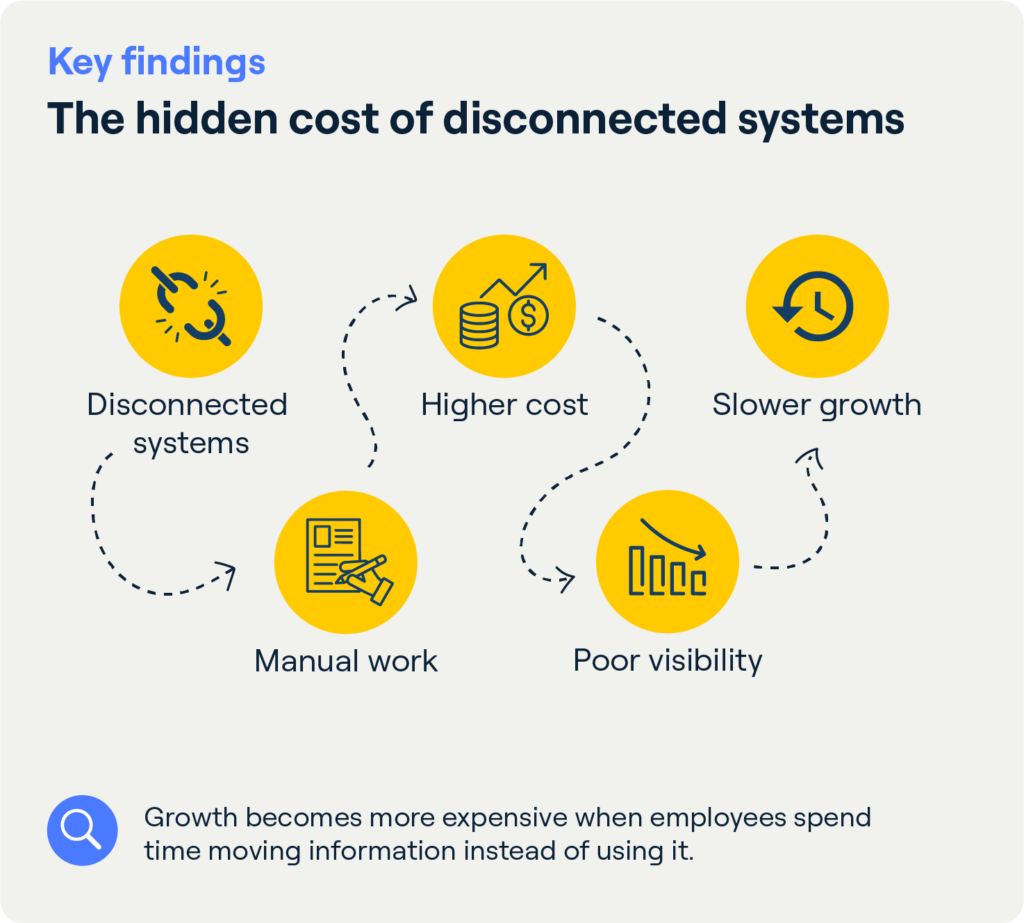
But the more we examined the results, the more difficult it became to view these findings in isolation. In fact, there is a logical thread connecting them all: When systems fail to share information automatically, work does not disappear… It simply moves to people.
Information must be copied manually. Reports must be consolidated manually. Customer data must be checked across multiple platforms. Employees spend time acting as the bridge between systems that should already be connected.
What appears to be four separate operational challenges may actually be one challenge revealing itself in different ways.
What are disconnected systems?
The term “disconnected systems” sounds technical, but the reality is familiar to most travel agencies.
A disconnected system is any platform that cannot automatically share relevant information with the rest of the business.
In practice, this often means customer information lives in one system, booking data in another, financial information somewhere else, and marketing or service interactions in separate tools.
The systems themselves may work perfectly well. The challenge arises when information cannot move seamlessly between them.
When that happens, employees become responsible for connecting the dots. Data is entered multiple times, reports must be consolidated manually, and teams spend valuable time searching for information that already exists elsewhere in the business.
This is why disconnected systems are often associated with manual work, higher operating costs, and limited visibility. The issue is rarely the individual systems. It is the lack of connection between them.
Key takeaway from the article
- 50% of travel agencies report disconnected systems as a major operational challenge.
- Many operational challenges share the same root cause. Manual work, rising costs, reporting issues, and inefficiencies often stem from information not flowing effectively across the business.
- Connected data is the foundation for automation and AI. Agencies cannot automate processes or leverage AI effectively if critical information remains fragmented across systems.
- Integration may be a bigger opportunity than new technology. Improving how existing systems work together can unlock significant productivity gains without expanding the technology stack.
How fragmented data increases operational costs in travel agencies
Consider a typical customer journey.
A new inquiry arrives through a website form. The customer record is created in a CRM. Booking information is managed in another platform. Marketing communications are tracked elsewhere. Financial information sits in an accounting system.
None of these systems are problematic on their own.
The challenge emerges when they cannot exchange information automatically.
At that point, every department develops workarounds. Teams create spreadsheets. Information is copied and pasted. Processes evolve around the limitations of the technology rather than the needs of the customer.
Over time, these workarounds become normal. But normal does not mean efficient.
Every manual handoff introduces the risk of
- delays
- duplicate work
- inconsistent data
- fragmented reporting
- higher operating costs
More importantly, it consumes time that could otherwise be spent serving customers, improving operations, or generating revenue.
Why connected data matters for automation, AI adoption, and scalable growth
For years, operational inefficiencies could be hidden by growth.
When demand increased, agencies could simply add more people. More bookings created more work, but they also generated more revenue. The inefficiencies remained, but they were easier to absorb.
That equation is becoming more difficult to sustain.
Across the industry, the conversation has shifted from growth to productivity. Agencies are investing in automation, exploring AI, and seeking ways to scale without increasing headcount at the same pace as their booking volume.
That is where disconnected systems become a problem.
Because every automation initiative depends on data flowing across the business. Every AI initiative depends on having access to consistent and reliable information.
Ultimately, when customer data lives in one system, booking information in another, and reporting in yet another, agencies often discover that the biggest barrier to automation is not the technology itself. It is the operational foundation underneath it.
The same applies to growth.
Every booking, customer interaction, and reporting request becomes more expensive when employees spend their time moving information rather than using it. As volume increases, so does the amount of administrative work required to support it.
What once looked like a minor inefficiency begins to constrain productivity, and as agencies pursue automation, AI, and growth, that hidden cost becomes increasingly difficult to ignore.
How high-performing travel agencies connect systems and reduce manual work
When we look across the benchmark data, a pattern emerges.
The agencies that are best positioned for automation, AI adoption, and scalable growth tend to share one characteristic: information flows more freely across the business.
Customer data, booking information, operational reporting, and financial insights are not isolated within individual departments.
Instead, they become shared assets that support decision-making across the organization.
This creates several advantages:
- Less manual administration
- Faster access to information
- Better reporting visibility
- Greater consistency across teams
- Stronger foundations for automation and AI
In short, they spend less time managing information and more time acting on it.
How travel agencies can reduce manual work and improve operational efficiency
The good news is that solving this challenge rarely starts with buying another system.
More often, it starts with improving how existing systems work together.
Based on the benchmark findings, agencies should consider four actions:
1. Identify where data is entered more than once
- Every duplicated data entry process is a signal that information is not flowing effectively.
- Map the customer journey and identify where employees manually move information between systems.
2. Prioritize integrations before new technology
- Many agencies respond to operational challenges by adding another platform.
- Often, greater value comes from connecting existing systems rather than expanding the technology stack.
3. Measure administrative workload
- Most agencies track bookings, revenue, and customer satisfaction. Fewer track the amount of time employees spend on repetitive administrative work.
- Understanding this hidden workload is often the first step toward reducing it.
4. Build an integration-first strategy
- Automation and AI depend on connected data.
- Before investing heavily in new initiatives, ensure the underlying operational infrastructure allows information to move seamlessly across the business.
*The data in this article was collected in the worldwide “State of Travel Agency Operations” survey conducted from October 20, 2025, through November 20, 2025, by TravelOperations.
Frequently asked questions
What is operational efficiency in a travel agency?
Operational efficiency is the ability to process bookings, serve customers, and manage workflows with the least possible manual effort and cost.
What are disconnected systems in a travel agency?
Disconnected systems are software platforms that do not automatically exchange information. Examples include CRMs, booking systems, accounting software, customer service tools, and marketing platforms operating independently.
What is the consequence of disconnected systems in a travel agency?
Disconnected systems increase manual work, raise operating costs, reduce reporting visibility, and make AI adoption more difficult.
Why do disconnected systems increase operational costs?
Employees spend more time entering data, reconciling information, producing reports, and managing workflows between systems. This increases administrative workload and reduces productivity.
Why do disconnected systems make AI adoption difficult?
AI depends on access to reliable and connected data. When information is fragmented across multiple systems, AI has limited context and cannot perform optimally.
What is the business impact of disconnected systems?
The most common impacts are:
- Higher operating costs
- More manual work
- Poorer reporting
- Reduced productivity
- Slower scalability
How can travel agencies solve disconnected systems?
By prioritizing integrations, reducing duplicate data entry, standardizing workflows, and creating a connected operational infrastructure.
Looking for more inspiration?
Discover articles, guides, reports, and customer stories
-

AI in travel: Finding patterns in BSP exceptions
Discover how an AI agent can help travel agencies investigate BSP reconciliation exceptions
-

AI in travel: From manual reconciliation to intelligent exception management
Why travel finance is the perfect use case for AI agents
-

Webinar: AI agents in action (on-demand)
Watch this practical webinar to see two functioning AI agents built for your travel agency’s finance team.