TravelOperations CRM + ERP, connected
Two systems. A third layer of value
Travel CRM gives you customer and commercial context. ERP/mid and back-office provides booking, operational, and financial context.
When they work together on one connected platform, they create value that neither system can deliver independently. Your agency gains connected business context that supports better processes, more meaningful insight, and more effective automation and AI.

Keep processes moving
Let customer, operational, and financial workflows continue across departments with fewer manual handovers.
Understand what
drives performance
Connect commercial activity with operational effort and financial outcomes to give teams a better foundation for decisions.
Enable smarter automation and AI
Use connected, governed data to automate workflows, surface exceptions, and support faster action across teams.
The full picture in one place
Connect every single signal
A customer account can look healthy from the commercial side because opportunities and activity are growing. But operations may be handling more changes, service work, and exceptions, while finance sees rising costs or slower payments.
Whit TravelOperations, CRM and ERP/mid and back-office share the same platform, enabling teams to assess commercial growth alongside delivery effort and financial outcomes.
This makes it easier to identify which relationships are growing sustainably, which require disproportionate effort, and where commercial, operational, or financial follow-up is needed.

Foundation for AI and agents
Give AI the context to support work across the agency
AI becomes more useful when it understands the process it supports and can work with reliable information from across the business. When customer, operational, and financial data remain separated, it sees only part of the picture.
With Travel CRM and ERP/mid and back-office on the same Microsoft Dynamics 365 foundation, automation and AI agents can build on broader business context. This creates a practical foundation for monitoring processes, identifying exceptions, coordinating follow-up, and introducing more advanced AI capabilities over time.
A connected platform makes AI more useful across the agency in three practical ways:
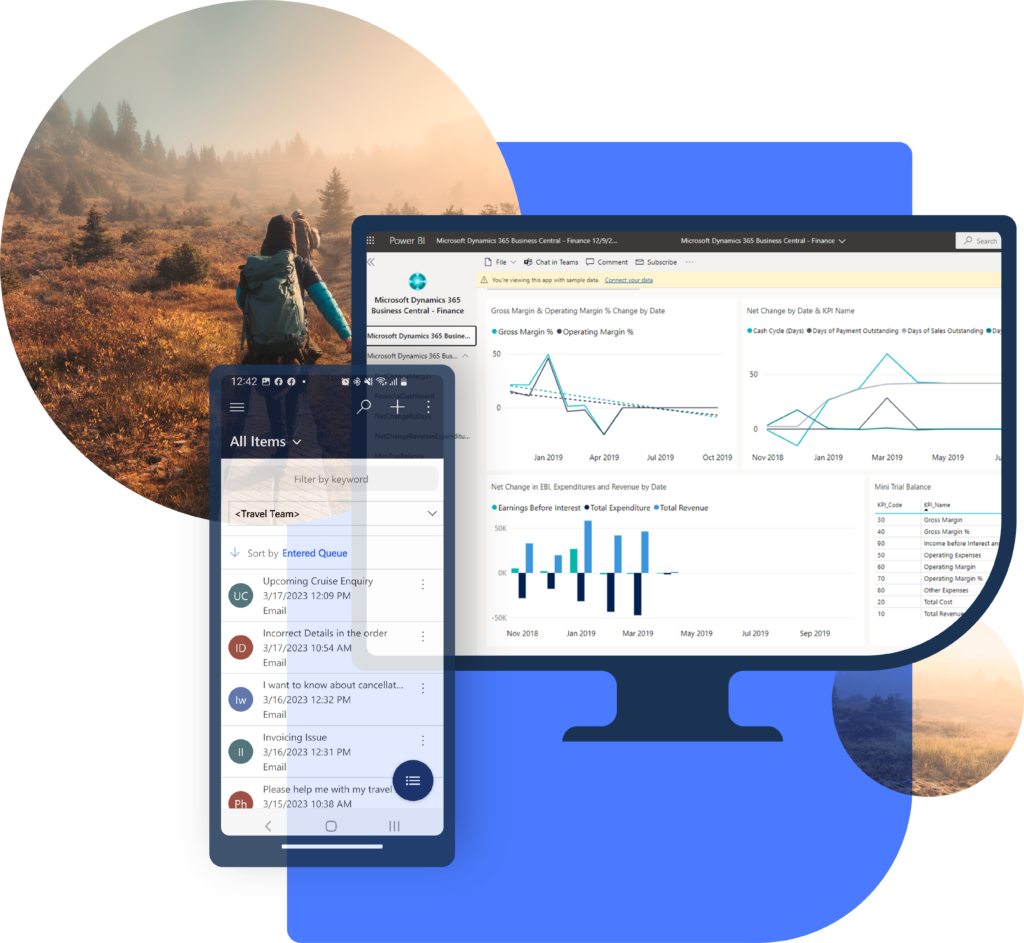
Give AI broader business context
Bring relevant customer, booking, operational, and financial context together so AI can provide more complete summaries, analysis, and support.
Use AI to move work forward across teams
Use automation and agents to surface exceptions, initiate approved actions, and coordinate follow-up across commercial, operational, and financial processes.
Scale AI with stronger governance
Apply shared data, permissions, workflows, and governance across AI use cases to support a more consistent approach between departments.

Connect agency workflows
Keep processes moving when work changes hands
Many travel agency processes cross commercial, operational, and financial teams. When those teams work in separate systems, each handover can create another email, spreadsheet, manual update, or follow-up task.
With Travel CRM and ERP/mid and back-office on the same Microsoft Dynamics 365 foundation, relevant activity in one part of the business can support the next step elsewhere. A customer change can initiate operational follow-up. An exception can alert the right teams. A financial issue can create the context needed for account management or management action.
This does not mean every process becomes fully automated. It means workflows, notifications, approvals, and tasks can be designed around the full business process rather than stopping at the boundary between two systems.
The result is fewer gaps between departments, clearer ownership, faster follow-up, and processes that are easier to improve as the agency grows
The difference explained
More than an integration between two systems
With TravelOperations, CRM and ERP/mid and back-office share the same Microsoft Dynamics 365 foundation. This creates a more consistent environment for connecting processes, reporting, governance, automation, and future development across the business.
A standard integration is different, and can only move selected data between a CRM and an ERP. But the systems may still rely on separate workflows, reporting models, permissions, automation tools, and development environments.
CRM & ERP connected through integrations only
- Selected data moves through defined integrations.
- Workflows are often managed separately within each system.
- Reporting may require information to be combined across different data environments.
- Automation and development follow the tools and structure of each platform.
- Changes must be coordinated across different technology environments.
Travel CRM & ERP on one connected platform
- Relevant data can support connected processes and reporting.
- Workflows can coordinate activity across business functions.
- Commercial, operational, and financial context can be analyzed together.
- Reporting, automation, apps, and AI can follow a more consistent platform strategy.
- Future development can build on the same Microsoft Dynamics 365 foundation.
Clear answers about the TravelOperations platform
Is the connected platform a separate TravelOperations product?
No. The connected platform is the combination of TravelOperations Travel CRM and ERP/mid and back-office on the same Microsoft Dynamics 365 foundation.
The added value comes from how data and processes can work across both systems. When both are in place, they can support connected workflows, broader reporting, shared business context, and a stronger foundation for automation and AI.
What additional benefits do we gain by implementing both systems?
Implementing both systems can help your agency connect information and processes across commercial, operational, and financial teams.
This can reduce manual handovers, provide more complete business context, and create a stronger foundation for cross-functional reporting, automation, and AI. The exact benefits depend on your processes, data, integrations, and configuration.
How is a shared platform different from integrating separate CRM and ERP systems?
An integration typically transfers selected data between two separate systems. The systems may still use different workflow tools, reporting structures, permissions, automation environments, and development approaches.
Because TravelOperations CRM and ERP/mid and back-office share Microsoft Dynamics 365 as their foundation, data, workflows, reporting, governance, automation, and future development can follow a more consistent platform strategy.
Can we implement Travel CRM and ERP/mid and back-office in phases?
Yes. You can begin with the system that addresses your most immediate business priorities and introduce the second through a phased roadmap.
Because both systems share the same Microsoft Dynamics 365 foundation, the first implementation can support a broader connected-platform strategy over time.
Does a connected platform mean every department works in the same system?
No. Commercial, operational, and financial teams have different responsibilities and need role-specific functionality, views, workflows, and permissions.
The benefit of the connected platform is that these specialized working environments can share relevant data and support coordinated processes across the business.
What data and workflows can be connected across Travel CRM and ERP?
Depending on the agency’s setup, the platform can connect relevant customer, account, booking, operational, transaction, and financial information.
Connected workflows may support tasks, notifications, approvals, exception handling, reporting, and follow-up across departments. The specific data flows and workflows are defined during the solution and implementation process.
How does the connected platform support AI and agents?
AI and agents become more useful when they can work with relevant, reliable, and governed information from across the business.
A connected platform can provide broader customer, operational, and financial context while supporting shared permissions, workflows, and governance. This can help AI summarize information, surface exceptions, support follow-up, and assist with cross-functional processes.
The quality of the results still depends on data quality, process design, permissions, and human oversight.
Want to know more?
Discover how connecting CRM and ERP could benefit your agency
Talk with our team about the handovers, reporting gaps, and automation opportunities across your current setup. Fill in the form and one of our solution experts will get in touch with you.
Travel Insights
Inspiration for your travel business
Discover customer references, articles, webinars, and guides – all made to help you succeed.
-

AI in travel: Finding patterns in BSP exceptions
Discover how an AI agent can help travel agencies investigate BSP reconciliation exceptions
-

AI in travel: From manual reconciliation to intelligent exception management
Why travel finance is the perfect use case for AI agents
-

Webinar: AI agents in action (on-demand)
Watch this practical webinar to see two functioning AI agents built for your travel agency’s finance team.