Travel Agency Sales Performance: What actually drives results in the travel industry
Discover key data on the current state of travel agency sales.

The article in short
This article explores key data on the current state of travel agency sales. It’s based on insights from 144 agencies across 23 countries, collected in November 2025.
In short, this article will show you that response speed, conversion rates, and process consistency have a greater impact on revenue than lead volume. The data also reveals that agencies that track their funnel and respond quickly convert more bookings, while those with slower or inconsistent processes lose opportunities.
Travel agency sales performance depends less on demand and more on how demand is handled.
Sales performance in travel agencies refers to how effectively demand is converted into bookings through response speed, conversion rates, and process efficiency.
When sales performance is under pressure, the default response is often to generate more demand. More leads, more inquiries, more opportunities. The assumption is simple: if volume increases, revenue will follow.
However, the data suggests a different reality.
Across travel agencies of all sizes, demand is rarely the primary constraint. Instead, the challenge lies in what happens after demand is created: how quickly it is handled, how consistently it is tracked, and how effectively it is converted into bookings.
Sales performance is therefore not only a commercial question. It is just as much an operational one.
Key data insights on travel agency sales performance
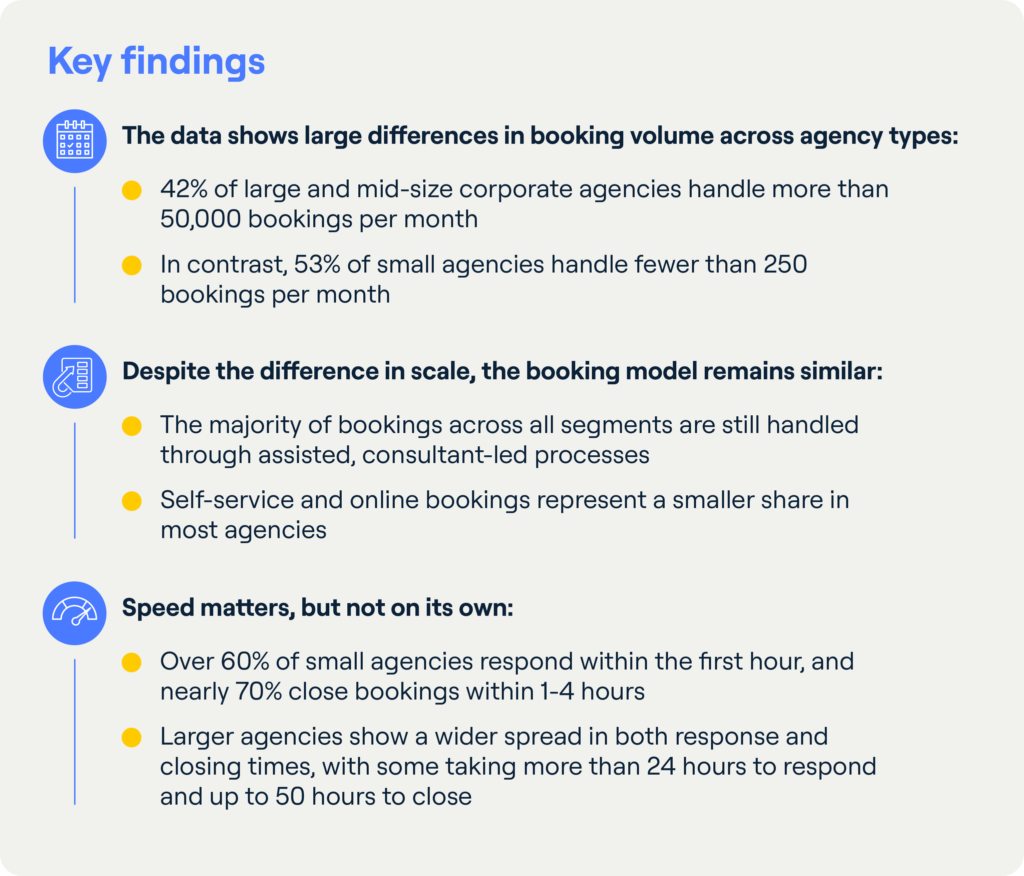
How scale impacts travel agency sales performance
At first glance, larger agencies appear to have a clear advantage.
- 42% of large and mid-size corporate agencies handle more than 50,000 bookings per month
- 53% of small agencies manage fewer than 250 bookings per month
This gap in scale is significant — but the way bookings are handled is not:
Across all segments, assisted sales still dominate. Among small agencies, 74% report that less than 25% of bookings are made through self-service channels. Even among large and mid-size leisure agencies, 66.7% remain in this same range. Corporate agencies show slightly higher digital adoption, yet 42% still report that less than a quarter of bookings are handled online.
The data shows that scale increases complexity, not efficiency.
As agencies grow, they do not remove operational effort — they scale it. More bookings require more coordination, more follow-up, and more time spent managing each step of the process. Without changes to how work is structured, scale increases pressure on the sales organization.
A clear pattern emerges from the data, with the first four challenges relating directly to travel agency operations and technology infrastructure, rather than market conditions. This suggests that for many agencies, improving performance may depend less on acquiring new customers and more on reducing operational friction across systems and workflows.
Where travel agency sales performance breaks down: the sales funnel
If demand is not the issue, the question becomes where performance begins to break down… The data points clearly to the sales funnel.
Small agencies: Conversion is spread across the entire funnel — from below 10% to above 75%. This shows that some agencies perform very well, while others struggle to convert demand consistently.
Large and mid-size leisure agencies: 41.7% report converting 25–49% of leads into opportunities. However, further down the funnel, performance drops, with 41.7% reporting that only 10–24% of opportunities result in a booking.
Large and mid-size corporate agencies: 33% report lead-to-opportunity conversion below 10%, and another 33% are not sure of their conversion rates at all.
Overall, the data shows that many agencies lack visibility into their own sales funnel.
When agencies do not know how their funnel performs, they are not actively managing it. Instead, they react to outcomes without clear insight into where opportunities are lost.
Why response speed impacts conversion
Another important factor shaping performance is speed — both in how quickly agencies respond and how long it takes to close a booking.
Smaller agencies tend to operate with a clear advantage. Over 60% respond within the first hour, and nearly 70% close bookings within 1–4 hours.
In larger agencies, the picture becomes more mixed.
Among large and mid-size leisure agencies, response times are more spread out. 25% report response times between 12–24 hours, and 16.7% take more than 24 hours. One-third are not sure how quickly they respond.
Corporate agencies show a similar pattern. While 25% respond within 15 minutes, others take significantly longer — and 25% report not knowing their response time. When it comes to closing business, 33.4% report that it takes between 25 and 50 hours.
This is where scale starts to create friction.
Smaller agencies operate with direct communication and fewer handovers. Larger agencies manage more complex workflows, involving multiple systems, stakeholders, and approval layers.
The result is increased friction. Speed remains a competitive advantage — but maintaining it becomes harder as complexity increases.
The key drivers of travel agency sales performance
The data shows that sales performance is not driven by a single factor. Instead it depends on how multiple elements work together:
- generating demand
- responding quickly
- converting opportunities
- closing bookings efficiently
- retaining customers over time
Agencies differ widely across these dimensions. Some convert more than 50% of opportunities into bookings, while others operate below 10%, and a meaningful share cannot report their performance at all.
Sales performance depends on execution, not just demand.
High-performing agencies combine:
- fast response times
- clear funnel visibility
- efficient processes
Each element reinforces the others. Faster response improves conversion. Better visibility highlights bottlenecks. Efficient processes increase consistency.
When these elements are aligned, performance becomes predictable and scalable.
What this means for improving travel agency sales performance
The data makes one thing clear:
Performance gaps are rarely driven by demand — they are driven by how demand is handled.
An agency may generate a high volume of leads, but if response times vary or conversion is not tracked, much of that demand will not translate into bookings.
Improving sales performance starts with improving operational consistency:
- reducing delays
- increasing transparency
- creating clear ownership across the funnel
Put differently, sales performance is not defined by how much demand enters the funnel, but by how effectively that demand is converted into revenue.
How to improve travel agency sales performance in practice
Based on the data, agencies should focus on four actions:
1. Track your funnel consistently
Measure conversion from lead to opportunity and from opportunity to booking.
2. Reduce response time
Faster response increases the likelihood of conversion.
3. Standardize sales processes
Ensure consistent handling of inquiries, follow-ups, and bookings.
4. Identify bottlenecks
Focus on where leads drop off and where delays occur.
Summary: What drives travel agency sales performance
If you take three things from this article, they are:
- Travel agency sales performance depends on how demand is handled, not just how much demand is generated.
- Conversion rates, response time, and process consistency are the key factors that determine how effectively leads turn into bookings.
- Agencies that improve visibility and reduce friction across the sales funnel are better positioned to scale performance.
*The data in this article was collected in the worldwide ‘State of Travel Agency Operations’ survey conducted from October 20, 2025, through November 20, 2025, by TravelOperations.
Also available in this series: 5 priorities leaders should focus on in 2026
Frequently asked questions about travel agency sales performance
What is the biggest challenge in travel agency sales performance?
The main challenge is not generating demand, but converting it. Agencies struggle with response time, inconsistent processes, and limited visibility into their sales funnel.
Do travel agencies need more leads to improve sales?
Not necessarily. Many agencies already generate sufficient demand. Performance depends on how effectively that demand is handled and converted.
How does response time affect booking conversion?
Faster response increases the likelihood of conversion. Agencies that respond quickly tend to close bookings faster and more consistently.
Why do larger agencies struggle with sales efficiency?
Larger agencies manage more complex workflows, systems, and stakeholders. This increases friction and makes it harder to maintain speed and consistency.
What is the role of the sales funnel in performance?
The sales funnel determines how effectively demand is converted into bookings. Agencies that track and manage each stage perform more consistently.
Why doesn’t higher booking volume automatically improve performance?
Higher volume increases workload but not efficiency. Without structured processes, it can lead to longer sales cycles and missed opportunities.
Looking for more inspiration?
Discover more articles, insights, and customer stories
-

AI agents in action: Simplifying reconciliation and settlement work
Join this practical webinar to see two functioning AI agents built for your travel agency’s finance team.
-

Travel agency operations: Why disconnected systems are slowing agency growth
Discover how disconnected systems create manual work, increase operational costs, and make it harder for travel agencies to scale, automate, and adopt AI.
-

2026 trend report: Travel agency operations
Understand how travel agencies are adapting to rising operational complexity, changing customer expectations, and increasing pressure on sales and service performance.