Travel agency operations: Benchmark data reveals the 5 biggest operational challenges
Data tells the real story of what’s holding back travel agencies worldwide.

The article in short
The State of Travel Agency Operations benchmark highlights a clear pattern emerging across the industry: Many travel agencies report operational challenges that slow everyday work, particularly manual data entry, disconnected systems, and rising operational costs.
While agencies continue to serve loyal customers, these workflow and technology gaps can limit productivity as businesses grow. The findings suggest that improving how operations and systems work together may play an important role in supporting the next phase of agency performance.
Benchmark data reveals where operational friction is slowing travel agencies down
Travel agencies are entering a period where operational performance matters as much as demand. Booking values are rising and travel demand remains strong in many markets, yet many agencies are discovering that growth also exposes structural weaknesses in how work is executed.
Insights from the State of Travel Agency Operations benchmark reveal that the biggest operational challenges in travel agencies are not primarily market-related. Instead, they stem from how travel agency operations are structured, including manual workflows, disconnected systems, and limited operational visibility.
In other words, the industry’s primary friction point appears to be internal operational efficiency rather than customer demand.
The top 5 operational challenges in travel agency operations
The benchmark data highlights five operational challenges that appear most frequently across participating agencies.
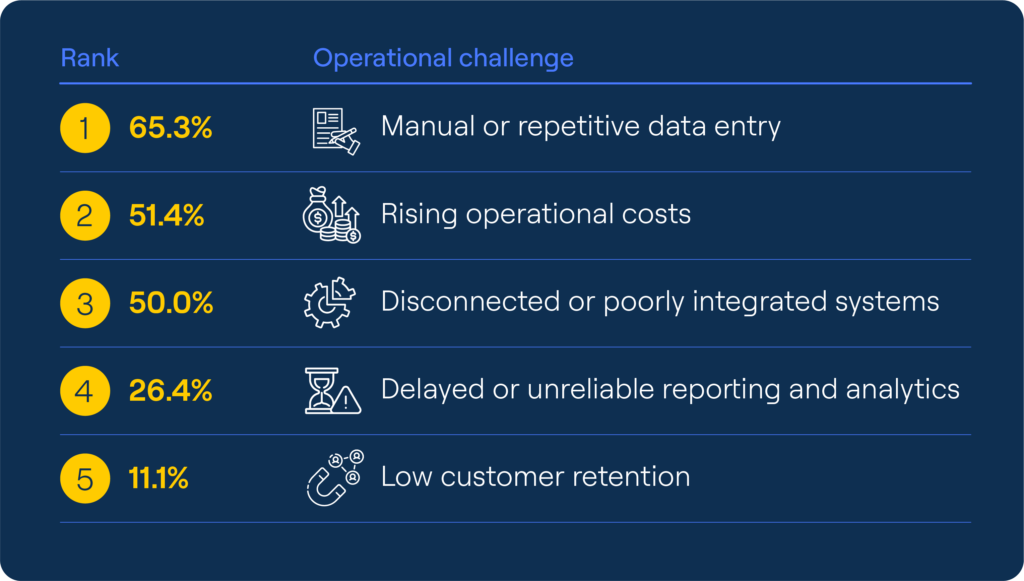
A clear pattern emerges from the data.
The first four challenges relate directly to travel agency operations and technology infrastructure, rather than market conditions. This suggests that for many agencies, improving performance may depend less on acquiring new customers and more on reducing operational friction across systems and workflows.
1. Workflow inefficiency is the dominant challenge in travel agency operations
The most widely reported challenge is manual or repetitive data entry, cited by 65.3% of agencies.
At the same time, 50.0% report disconnected or poorly integrated systems.
Together, these findings point to a structural issue affecting many travel agency operations: workflows often span multiple systems that do not communicate seamlessly. As a result, staff frequently need to re-enter information or manually coordinate processes across different platforms.
These types of manual processes can create several operational consequences:
- Repeated data entry across systems
- Increased risk of human error
- Slower processing times for bookings and service requests
- Higher dependence on staff capacity
Rather than isolated inefficiencies, the benchmark data suggests that workflow friction may be embedded in how many travel agencies operate today.
As booking volumes increase, these manual steps scale directly with workload.
2. Rising operational costs may reflect workflow inefficiency
More than half of agencies (51.4%) report rising operational costs as a key operational challenge.
While external factors such as inflation or supplier pricing can contribute to cost pressure, the data suggests another potential driver: labor-intensive workflows.
When operational processes rely heavily on manual coordination between systems, scaling bookings often requires additional staff time. Each booking can trigger multiple administrative steps, data transfers, or service follow-ups.
In this context, cost pressure in travel agencies may partly reflect productivity constraints within travel agency operations, rather than purely external market conditions.
Reducing manual workflow steps and improving system integration may therefore play a critical role in improving operational efficiency.
3. System integration remains a structural challenge
Half of the agencies in the benchmark report disconnected or poorly integrated systems as a major operational challenge.
Over time, many travel agencies have adopted different systems to support booking management, CRM, accounting, communication, and documentation. While each system may solve a specific operational need, the lack of integration between them can create fragmented workflows.
Without reliable system integration, agencies often face:
- Duplicate data entry
- Inconsistent information across platforms
- Limited operational visibility
- Increased administrative workload
These challenges reinforce the idea that improving travel agency operations often requires better coordination between systems, not simply adding new technology.
4. Reporting and operational visibility remain uneven
Another operational challenge identified in the benchmark is delayed or unreliable reporting and analytics, reported by 26.4% of agencies.
Operational reporting plays an important role in helping agencies understand how efficiently their operations are performing. Without timely data, it becomes harder to:
- track booking profitability
- monitor consultant productivity
- evaluate sales and marketing performance
- identify operational bottlenecks
The data suggests that operational visibility across travel agencies remains uneven, with some agencies having limited access to real-time performance insights.
This gap can make it more difficult for leaders to make proactive operational improvements.
5. Customer retention appears relatively stable
Only 11.1% of agencies report low customer retention as a major operational challenge.
Compared with workflow inefficiencies, cost pressures, and system integration issues, customer demand and loyalty appear relatively stable in the benchmark data.
This finding suggests that many agencies already maintain strong relationships with their clients. However, operational friction within travel agency operations can still limit how efficiently those relationships are served.
In other words, the constraint may lie less in demand and more in operational execution.
Workforce challenges appear less prominent in the data
In contrast to the more dominant workflow challenges reported, the benchmark data reveal that workforce challenges appear less frequently than many expected
Only:
- 5.6% report high employee turnover
- 1.4% report employee dissatisfaction
Given ongoing industry discussions about staffing shortages, these relatively low percentages are notable.
The findings suggest that for many agencies, technology and workflow inefficiencies may currently represent a more immediate operational challenge than talent retention.
What the data suggests about the future of travel agency operations
Put together, the benchmark insights point to a broader pattern within the industry:
The most frequently reported operational challenges — manual processes, disconnected systems, rising costs, and limited reporting visibility — all relate to how travel agency operations are structured and supported by technology.
This suggests that improving operational performance may depend less on market expansion or customer acquisition, and more on designing workflows and systems that allow agencies to operate more efficiently as they scale.
Travel agencies have always been highly process-driven businesses. As booking complexity increases and customer expectations continue to rise, the ability to streamline workflows and integrate systems may become an increasingly important competitive advantage.
Also available in this series: 5 priorities leaders should focus on in 2026
*The data in this article was collected in the worldwide ‘State of Travel Agency Operations’ survey conducted from October 20, 2025, through November 20, 2025, by TravelOperations.
Frequently asked questions about travel agency operational challenges
What are the biggest operational challenges in travel agencies today?
The most common operational challenges in travel agencies include manual or repetitive data entry, disconnected systems, rising operational costs, delayed reporting, and workflow inefficiencies. Benchmark data suggests that many travel agency operations struggle with manual processes and limited system integration, which can slow workflows and increase operational costs.
Why do travel agencies struggle with manual workflows?
Many travel agencies rely on multiple systems that do not integrate seamlessly. This often requires consultants or operations staff to manually enter data across platforms during booking and service processes. These manual processes create workflow inefficiencies and increase the time required to handle bookings and customer requests.
How can travel agencies improve operational efficiency?
Improving travel agency operations often involves reducing manual workflows, integrating operational systems, and improving reporting visibility. Agencies that streamline processes and reduce duplicate data entry can increase productivity and scale bookings more efficiently without proportionally increasing operational workload.
Looking for more inspiration?
Discover more articles, insights, and customer stories
-

AI agents in action: Simplifying reconciliation and settlement work
Join this practical webinar to see two functioning AI agents built for your travel agency’s finance team.
-

Travel agency operations: Why disconnected systems are slowing agency growth
Discover how disconnected systems create manual work, increase operational costs, and make it harder for travel agencies to scale, automate, and adopt AI.
-

2026 trend report: Travel agency operations
Understand how travel agencies are adapting to rising operational complexity, changing customer expectations, and increasing pressure on sales and service performance.